
37. African Queens
A hybrid of autofiction, memoir and criticism considering 2Face's debut Face 2 Face.

Twenty years ago, I was a frustrated school leaver trapped in Ibafo, a dusty satellite town near Lagos. A predicament entirely of my own making, I passed the University Matriculation Examinations on my first attempt. I was poised to study Medicine and Surgery at the Obafemi Awolowo University, Ile-Ife. But there was a year-long waiting period. A protracted strike by the lecturers’ union disrupted the academic calendar for a whole year. So, I waited at home for Ife’s call. My less fortunate peers who flunked their examinations were rewarded with a vibrant social life, attending preparatory lessons and A Level classes.
Indeed, no good deed goes unpunished. My punishment for excelling in my UMEs was the busy schedule of household chores that began at dawn with locking the house gate after my parents and ended at dusk with washing their cars for the next day's hurrah.
Cleaning cars was an exercise in futility, particularly in Ibafo. We lived at least five kilometres from the busy, shiny asphalt of the Lagos-Ibadan Expressway. My cleaning work was undone in less than three minutes of travel time; the car acquired a finish of dust, and I coughed and sneezed in my sleep from allergy and postnasal drips.
My parents had edged a bet on Ibafo, one of those satellite towns dotting the Lagos-Ibadan Expressway. Its selling point remains unclear; it was a short drive from Ojodu Berger, but Arepo and Magboro were closer to Lagos. All these towns were historically farm settlements, but as the Lagos commuters leaked, they became commuter towns for Lagosians who were disillusioned about paying exorbitant rent to suburban landlords. My parents bought land in a former pineapple plantation, built from scratch a five-bedroom bungalow with a marbled patio and waited for the poetic promises of basic amenities that still elude Ibafo today.
In 2004, that bungalow was my prison; my household chores were my hard labour. Mostly resigned to that sweltering heat, I found small pleasures in reading Ken Follett’s novels and listening to the R&B music of Carl Thomas, Usher Raymond and Donell Jones.
Mobile phones were already with us but unattainable for a school leaver who drew a modest monthly allowance predicated on good behaviour. I soured Christmas the previous year by breaking curfew early in December. I attended two parties at O’jez and 11:45, at Iwaya and Ikoyi, respectively. Then returned home at midnight to a furious father and a betrayed mother. By default, my mother was at fault for my wrongdoing. Worse, she accused me of authorising my wastrel sojourn. My militant father cut my modest allowance and doubled my household chores.
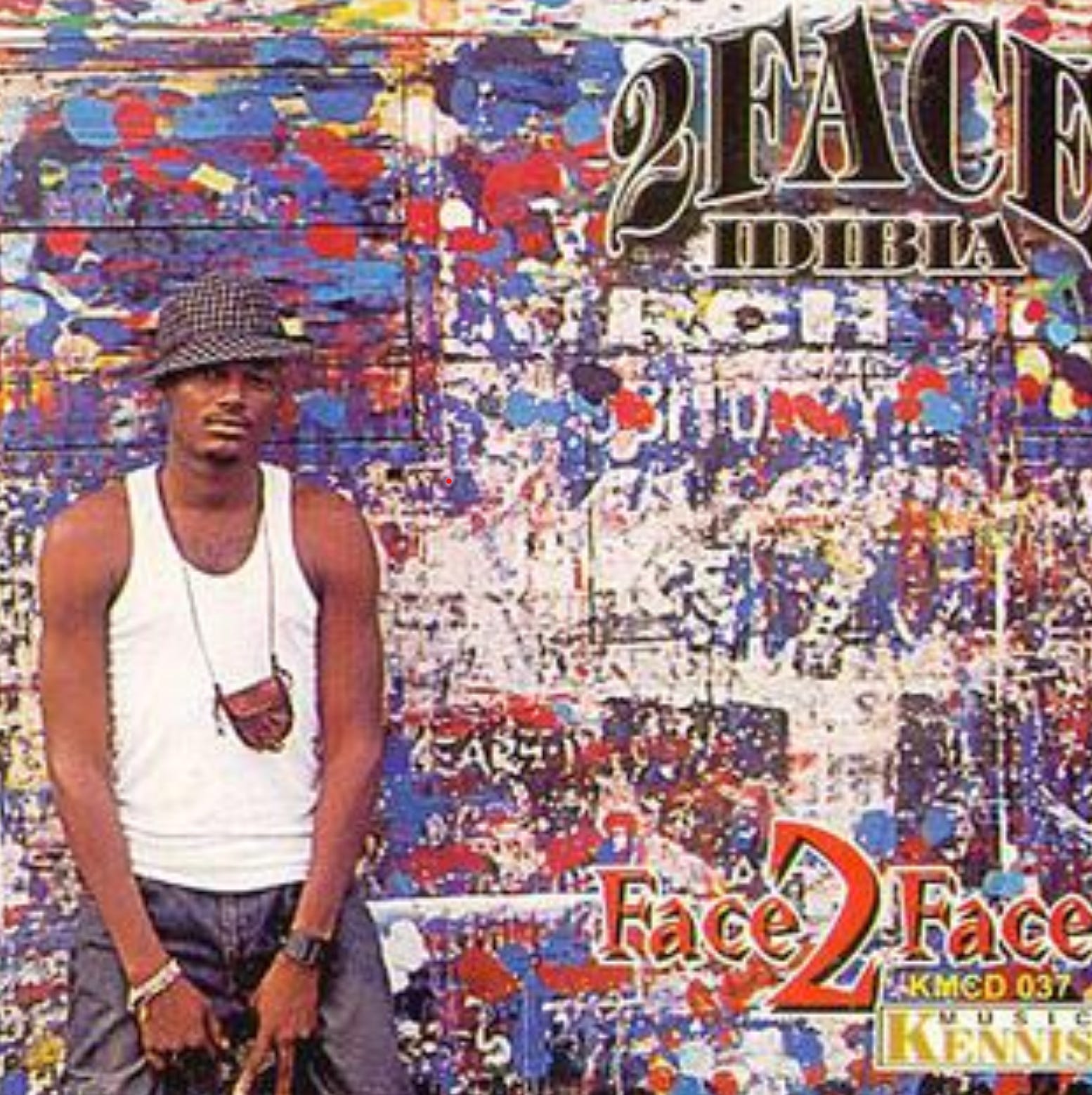
cover art 2Face’s Face 2 Face
Music was an escape from that sleepy town where boredom was the legal tender of youth. The radio was my redemption. In 2004, contemporary Nigerian music was yet to be called Afrobeats, Afro-Pop, or Afro-anything-that-tickles-your-fancy. It was called Naija Hip-Hop, Naija Pop, or simply Naija music. It was not particularly popular among my private school crowd, who preferred R&B music, Hip-Hop, and Rap.
Some radio stations privileged Nigerian music more than others, but their overall radio play lagged behind contemporary American music. Some called it a knock-off of American music, and this assessment was spot on. In its lyrical cadence, melodic styles, visual vocabulary, and fashion choices, Naija Pop crudely imitated Black American culture.
Fellow school leaver Tony lent me his copy of 2Face’s debut, Face2Face. Like myself, he was waiting to hear from his First Choice University. Like myself, he spent his day strolling aimlessly around the Ibafo. Sometimes, he ran errands in his father’s car. I would visit him, and we would sit in their yard, lounging in the cool evening breeze, drinking his father’s beer stash, discussing music.
Tony loved Jay-Z, and I loved Nas. In March 2004, he brought me an Alaba-pirated copy of Usher’s Confessions and played Track 5 ‘Burn’. On the day he brought me 2Face’s record, Tony was humming ‘African Queen’, terribly ecstatic, beaming about this new music he had just experienced. But there was more. He had gotten his get-out-jail card; Ambrose Alli University had beckoned.
I would wait until we powered our Lister diesel generator that evening before I felt that same joy of aural pleasures. I was happy Tony had found a legitimate route out of that town, but this had consequences for me. It meant no more lukewarm beers retrieved from his father’s fridge or those early morning calls when we would switch on the generator and burn through some good music. It also meant I was left in that godforsaken town, waiting for Ife.
We knew 2face Idibia was special. His vocal work on Tony Tetuila’s diss track ‘Omode Meta’ may be the first time in Naija Pop featured artists bodied the leading artist. The featured artists were Blackface, 2Face and Ruff, Rugged and Raw. They camped their tent with Tony Tetuila, the aggrieved and ousted member of the boy group The Remedies, not for altruistic reasons; they had come to Lagos for their reasons of fame and making their name. Whilst Blackface launched a verbal riposte targeted at Eedris Abdulkareem, 2face ad-libbed the chorus. Even now, thinking about him harmonising ‘sere o’, I feel goosebumps at the nape of my neck.
2004 marked the beginning of a new era in contemporary Nigerian music. Boy Bands had begun to split up for a different model of creative collaboration: an artist and producer, one operating in the studio booth, the other sitting with the console, both synergising.
After Plantashun Boys’ debut album, Body & Soul, released under Nelson Brown’s Dove Records, Tuface wanted more for himself. Blackface was the de facto leader, whilst 2Face, with that silky tenor, was the effortless star. They would disband, and court solo careers, of which 2Face’s was the first and perhaps the most impactful in Nigerian music lore.
Face 2 Face was entirely produced by OJB Jezreel. Heavy on skits that have aged poorly, the album truly opens at ‘Nfana Ibaga(No Problem)’. It starts in Hip-Hop mode, with a boom-bap beat. 2Face segues in with a confessional couplet, “I’m coming out straight this time/I am coming out with a little of my kind of piece of mine.” An airy but solemn string solo underscores his words, and when he quickens his tempo, his end rhymes are bracketed with a grumbling bassline.
With subtle changes from the heady strings to the grumbling bassline to the syncopated drum work intermission towards the end of the track, OJB Jezreel’s production on ‘Nfana Ibaga’ was active and lively in the way a diss track is.
2Face seemed ready to take his destiny into his hands. He had played second fiddle through this music enterprise, content with waxing ad-libs and harmonies. It was the opportune time, this moment, for him to tell his own story, enact his own philosophy, and bring his own song to a teeming audience.
2Face confronted his future by launching his debut career. Ultimately, it was time for him to lose his innocence (pun intended). Perhaps this explains the album title, Face 2 Face. A title does not get more confrontational. Maybe it is also a tribute to that ramshackle urbane living arrangement called Face Me I Face You, where tenants’ rooms face each other in an aggressive architecture orchestrated to maximise the landlord’s earnings.
We know this angst too well—of a talented individual taking a chance on himself. He must be true to himself in the studio booth. He confides in the microphone and belts out his song with soul. I know that feeling, that position of equipoise and diffidence. It is vulnerability’s sweet spot. You are cornered with tidal anxiety, an existential dread, and even claustrophobia in that studio booth.
The boxing gloves come off like on Sunny Ade & his African Beats 1974 album, E Kilo F’Omode. His time with his promoter and record label boss, Chief Abioro, has ended. He strikes out on his own. But what he has done can only be interpreted as subterfuge, a coup against friendly capitalism. Sunny Ade’s only fight was in the music. And it had to be perfect.
2Face was in that place, too, when he doubled down and offered that confessional couplet. Even more, when he raps, “I know some people will say some things that will cut like a knife/I know some people will say that I might never find a wife/But I'll do my thing my way oh my brother no be fight/Sometimes I might be wrong, sometimes I might be right/But I'll keep my head straight/And I'll keep my game tight.”
Music, in retrospect, is the soundtrack of nostalgia. But in the present, it accentuates or alleviates our state of mind. Those sweltering days waiting for resumption, this was music to pass the time, grovel in, and lose oneself in—alongside the occasional thrills I found.
Reading Follett’s novels became repetitive. His formulaic family sagas began to grate my nerves, and his writing was mechanical, like the chores that filled my day. With Tony out of the area, I rescinded deeper into myself.
Overtly socialising with the youth in the neighbourhood could have dire consequences, so I kept my distance. I would nod greetings at the liming youth on the roadside as I strolled to the cybercafe with my notebook. I was part of my poetry listserv, where I shared my blank verse poems, mostly about love, with retired white folks. I was returning from the cybercafe one evening, buzzing with compliments I had received about one of my poems when I ran into the boys discussing it. That was how I met Wale and found that our fates were similar.
Wale and Tony were both tall, heavyset, and flamboyant young men. But while Tony’s flamboyance resulted from guile and effortless social skills, Wale’s came from his physical abilities. He lived with his uncle’s family—and his household chores were much more than mine. Besides bathing and caring for his nephews, doing laundry for his uncle, and cleaning their four cars, he was also a chorister at his uncle’s church.
Wale was a beautiful tenor. He would close his eyes, tilt his neck, and belt out such beautiful music. When he was not singing gospel music, he enjoyed the White Boy Bands popular in Nigeria, particularly the Backstreet Boys and Westlife.
Wale loved to sing ‘African Queen.’ Visiting him en route to the cyber cafe soon became my routine. I would watch him hand-wash clothes. We would make small talk; there was very little to talk about. He was religious; I was at the cusp of questioning my faith. He could sing; I wouldn't stand my croak in the shower. He cared for soppy white boy bands; I loved hardcore hip-hop, traditional R&B, and neo-soul. But we bonded on ‘African Queen.’
Years later, I would write a poem titled ‘Queens’ after a song by German-Serria Leone musician Patrice, best known for his sublime fusion of reggae and soul. Queens, off his debut album, Ancient Spirit, is one of the most moving love songs I have heard. Wistful and rendered in low-tempo Jamaican patois, ‘Queens’ is an accomplishment compatible with Blackface’s creative vision for the ‘African Queen’.
In 2004, I had a love interest. I had no plectrum to strum a non-existent guitar. I had no silky tenor to hoist a ballad like Wale. I had a sheaf of poems and a formal obsession with end rhymes. If I wrote a poem after ‘African Queen’, it did not survive the onslaught of time–but this memory of Princess did.
Princess was a girl from around the way. She lived in Ughelli but had family ties with Ibafo. She would visit her older sibling during the long vacation holidays. It was during one of those holidays that I encountered her. She was tall and dark. Her smile showed a crowded dentition that drew me even closer to her.
She came up in my discussion with Tony. I offered a description, and in the manner of small towns where everyone knew everyone, Tony told me her name. Then took me to her sister’s house. It was an awkward visit, but the seed of affection was sown.
Ife finally beckoned in August, and I left Ibafo one week early to prepare for university. Uncle Abbey, my daddy’s demure driver, drove me down. The trip was remarkably different; he controlled the car stereo. I had 2Face’s Face2Face in hand, but he wanted to play his live Fuji records; those spontaneous sets are the equivalent of mixtapes made from Hip-Hop cyphers. At the time, I was a snobbish kid who had spent too much time with proper bougies like Kemi Badenoch.
I became independent in late adolescence with 2Face’s record in hand. I entered the sprawling undulating asphalt of Road 1 with some wonder. It was not my first time in Ife, but it was. I was finally free of Ibafo, the consuming dust, its humid heat, and, most importantly, that ennui all my chores could not cure. I had mixed feelings about leaving Princess in Ibafo, but she was also due to leave for Ughelli soon. She gave me her sister’s phone, her mother’s phone and her friend’s phone, which I proudly saved on my brand-new Nokia 3310.
Every student on campus owned a Face 2 Face, and in the public spaces, 2Face’s voice was everywhere at once, particularly at New Buka, where there was a cluster of restaurants facing each other and a concrete gazebo called Rotunda.
Ife tasted like freedom and financial means. Of the restaurants in New Buka, I favoured Grassroots, which a Ghanaian man runs. My usual order was eba, egusi soup and his tender, well-seasoned goatmeat. Dessert was a lager beer, Gulder. At the time, I was a brown-bottle man. Grassroots also rinsed 2Face’s album, although from speakers of a comparatively inferior quality.
Grassroots was not a chic restaurant; it was not the kind of place you would take a date if you wanted to impress. That would be Chicken Plaza or Spices. In those restaurants with elaborate woodwork and an ambience stoked by the smoky aroma of boiling stew, 2Face’s music was also on replay.
Listening to ‘African Queen’ was becoming a punishing experience. Everywhere you go, that simple guitar riff, those opening ad-libs, that grandiose, almost child-like declaration—You are my African Queen/Girl of my dreams/You make my heart go ding-a-ling-a-ling.
Encountering its bare lyrics could almost strip its magic. Without the musical alchemy backed by OJB Jezreel and 2Face’s soulful rendition, it is a tame love song comparing romance and royalty, platforming beauty on a pedestal, corralling natural scenery and landscape to flatter an ‘astonishing beauty’. And with every listen, that magic was tried and tested. Sometimes, you wish NEPA struck at New Buka, where the music was on repeat in every shop.
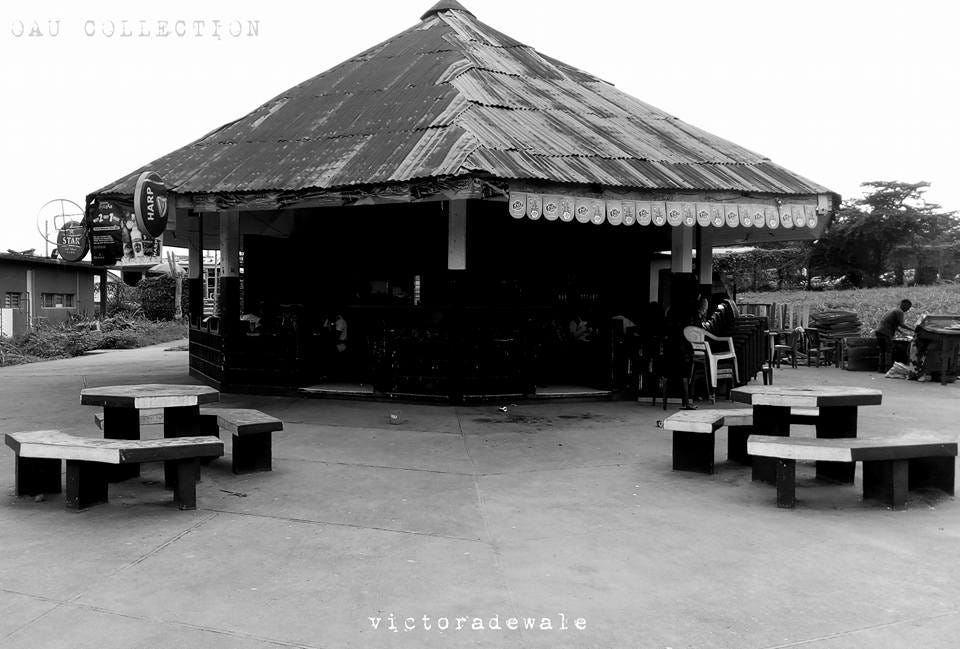
Photo credits: Victor Adewale
Frequent listening has its uses; it unearths gems. On Face2Face, ‘Ole’ is the superior love song. It chases a scenario and enacts a conflict. Something happens aside from a solemn declaration of love. The singer persona, battling unrequited love, accuses his love interest of being a thief of his metaphorical heart. It is a bold accusation because stealing requires an effort. Therein lies the paradox: that a girl, by being beautiful, courteous, and warm, traps the singer's persona. She is paid with his attention, the actual currency of affection, but she does not show that she cares in return, so he puts her on notice.
I thought about Princess and her beautiful body many nights before I was egged on to visit girls at the female hostel, Mozambique Hall. A stone's throw from my hall of residence, Angola Hall, almost every room played 2Face’s Face 2 Face.
There was a kind of hierarchy in Ife. New entrants were called Jambites, a pejorative term for freshmen. Jambito was a more amusing version the socially adept Staylite would use on a clear-eyed man asking for her telephone number.
Becoming a Staylite was a status symbol. For a medical student, it meant passing all your courses, including the one-unit courses that look inconsequential, but I would first endure the same as being a Jambite. Some sat in the freshman status with stoicism; others tried to finesse their way out.
A certain confident man walked into Awolowo Hall, heading for Angola Hall. His bounce was a close imitation of Denzel Washington’s Detective Alonzo Harris. Unbeknownst to him, he had gathered a following of clownish boys making faces behind him. Close to the Awo Annex gate overlooking Mozambique Hall, the boys gather around him, hailing Jambito!!!
Being a Jambite was not all mockery. There must have been a thousand welcome parties organised. The elaborate ones had DJs playing 2Face’s bouncy dancehall-leaning mirth-rallying ‘Keep on Rocking’. Unlike the forceful Galala, which was almost entirely a preserve of male dancers, you could catch a girl like Ishan bursting a subtle Swo at the Pharmacy foyer. Wacky lyrics notwithstanding, we partially did what the song instructed; we caught a vibe and prayed not to get a feeling.
Regarding feelings, Princess was on the fringes of my mind. She had no mobile phone, so I could not be as expressive and spontaneous as I wanted. I would miss her unscheduled calls during the day while attending lectures, dancing at one of those parties at night or mulling over a Gulder at New Buka inundated with echoes of 2Face’s voices. Then my 3310 fell from my top bunk bed to its premature death, and that put paid to that romance.
There were other love interests. One was a fellow Jambite studying law. She was bespectacled, and I was mildly embarrassed when I first saw her barefoot and in white robes heading to church on Sunday. She was reserved and a lot wiser than I was. She knew how to exploit my affection like that female character in ‘Ole’. I would visit her room in Mozambique Hall most nights, timed perfectly to catch her before she returned to class to read. She wondered if I ever read; I boasted that I was almost a genius.
She would drop hints about hunger and muse about a specific meal, usually with Spice’s grilled chicken. I would ask to take her to Spices, but she suggested I bring her the meal at the Law Lecture Theatre. I would walk through a bush path to New Buka. Hop on an Okada to get the piping hot meal to her. Waiting in vain for her affection. The scales fell off one Sunday when I strolled into Spices and found her in her white robes with a barefooted man who looked like a Staylite.
I left, sure that she saw me. I walked to Rotunda and ordered a bottle of Gulder. I mulled over my beer, listening to ‘Right Here’, a love song about reconciliation. What did I expect? For her to leave the Staylite and race after me like an old Nollywood flick? Rita Dominic’s character is eating fried chicken and rice with Clem Ohaneze. Jim Iyke saunters in, locks eyes with Rita, and storms out of the restaurant. A troubled Rita Dominic leaves Clem Ohaneze, the table, the fried chicken, rice, and orange juice, chasing after Jim Iyke. She finds him mulling over a beer, making physical overtures. He sulks but gives in to her pleas, partly because 2Face is reassuringly singing in pidgin about his love.
Instead, I watched them leave Spices together, holding hands in their luxuriant white robes. My visits to her room became more infrequent. I doubt if she hardly noticed. Welcome parties dwindled. Social activities declined. Lectures ramped up into full swing, and lecturers started threatening mid-semester tests.
I listened less and less to 2Face’s record and fought to keep my matriculation number to become a doctor.
I live in Abeokuta, actually and my maternal’s hometown is in Owode Idiroko. One of the routes we take there is along Mowe-Ibafo. One time we were traveling for Eid festival, we almost had an accident along that route and for some reason, that place stuck with me. Anytime I pass there, I just remember that memory.
As an OAU undergraduate, reading this feels like such a needed gift. I absolutely enjoyed how this is intertwined with Ibafo, a place I'm also quite familiar with. Elements such as the ironical friendship, the love and longing and most of all, the musical part were all so joyful to savor. Thank you very much for writing this, Dami. Thank you.